

Every chef understands the importance of protecting and organizing their knives. Whether you are a culinary student, professional chef, or passionate home cook, the way you transport your knives and tools matters.
For that very reason, two of the most popular options are knife rolls and knife bags. While both are designed to carry knives safely, they differ significantly in design, storage capacity, portability, and overall functionality.
Understanding the strengths and limitations of each option can help you invest in the right option. And this is exactly what we are going to help you with today.
What is a Knife Roll?
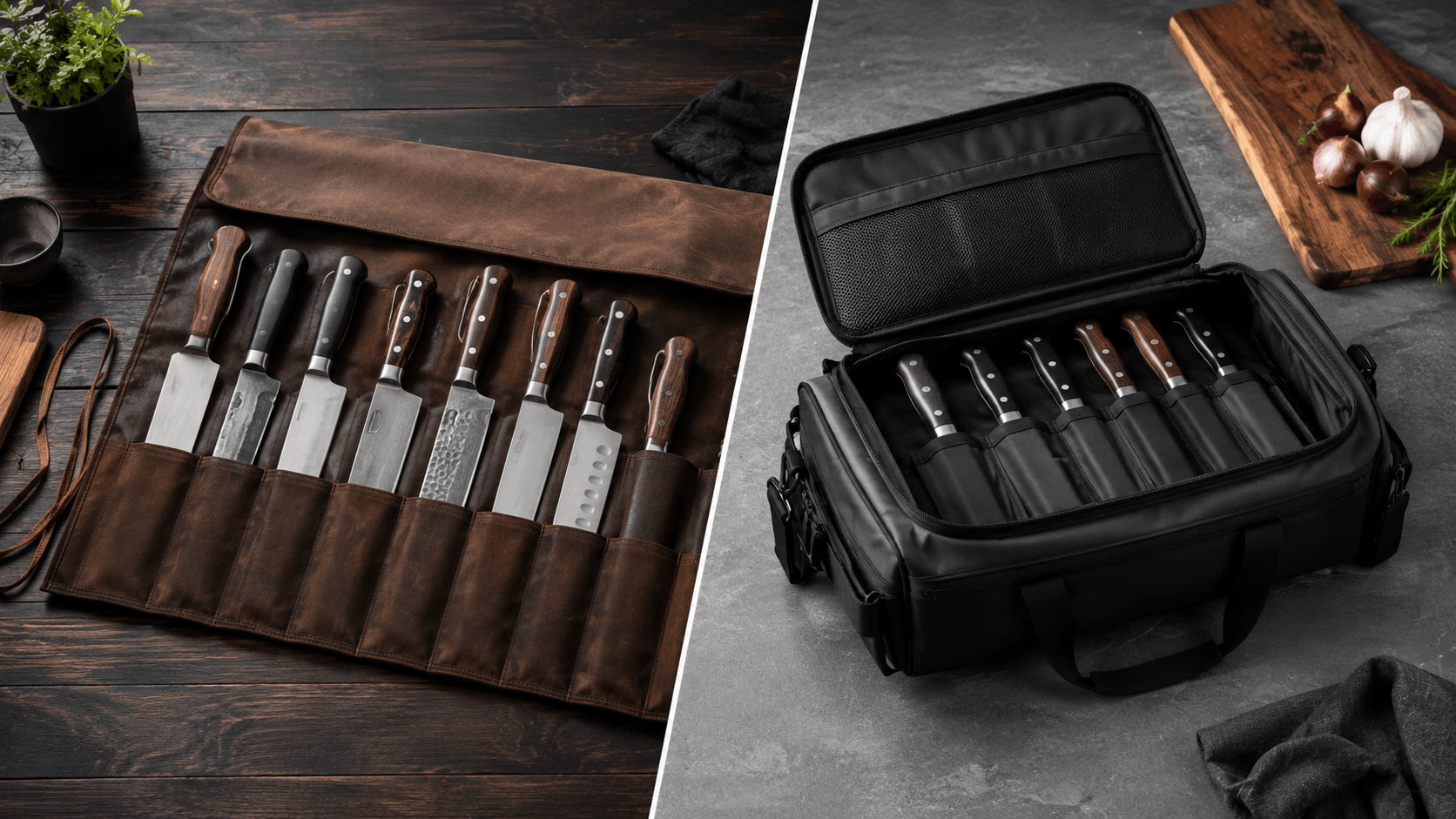
A knife roll is a compact storage solution designed to organize and transport knives securely. It typically features individual knife slots that keep blades separated and protected during travel.
Once loaded, the roll folds or rolls into a compact package that can be secured with straps, buckles, or closures. Professional chefs often favor leather knife rolls because they offer an excellent balance of portability, organization, and durability.
Many modern knife rolls also include utility pockets for accessories such as thermometers, tweezers, sharpeners, and pens. Their lightweight design makes them ideal for chefs who frequently move between kitchens, catering events, or culinary schools.
In addition to functionality, leather knife rolls are valued for their timeless appearance and craftsmanship, making them a popular choice among culinary professionals who appreciate both performance and style.
What is a Knife Bag?
A knife bag is a larger carrying case designed to store knives along with a wider range of culinary tools and accessories. Unlike a traditional roll, a knife bag usually resembles a briefcase, backpack, or messenger-style carrier. It contains multiple compartments, zippered pockets, and storage sections for organizing equipment.
Knife bags are popular among chefs who carry extensive collections of knives, kitchen gadgets, notebooks, uniforms, and other professional essentials. Their larger size allows users to transport more gear in a single bag.
Many knife bags also feature padded interiors, shoulder straps, and reinforced construction for added convenience. While they may not offer the traditional appeal of a leather knife roll, knife bags provide versatility and capacity for professionals who need to carry a wide variety of tools throughout their workday.
Pros and Cons of a Knife Roll
Pros
Compact and Easy to Carry
One of the biggest advantages of a knife roll is its compact design. It takes up minimal space while securely holding essential knives and tools. This makes it ideal for chefs who frequently travel between kitchens or work in environments where storage space is limited.
A knife roll can easily fit into vehicles, lockers, and workstations without becoming cumbersome. Its lightweight nature also reduces carrying fatigue during daily transportation, making it a practical option for busy culinary professionals.
Professional and Timeless Appearance
A quality leather knife roll delivers a classic and professional appearance that many chefs appreciate. Full-grain leather develops character over time and reflects craftsmanship, tradition, and attention to detail.
Unlike mass-produced storage options, a well-made knife roll often feels personal and unique. It complements the image of professional chefs who value quality tools and equipment. Beyond practical storage, a leather knife roll can become part of a chef’s professional identity, combining functionality with timeless style.
Cons
Limited Storage Capacity
Although knife rolls are highly efficient, they typically offer less storage space than knife bags. Chefs with extensive knife collections or numerous accessories may find themselves running out of room.
As more tools are added, the roll can become bulky and less practical. For professionals who regularly carry large amounts of equipment, a knife roll may not provide enough capacity to meet all their needs.
Less Suitable for Extra Equipment
Knife rolls are primarily designed for knives and a small number of accessories. While many include utility pockets, they generally lack the space needed for uniforms, notebooks, electronic devices, and larger culinary tools.
Chefs who carry a wide range of equipment may find themselves needing an additional bag. This can create inconvenience when traveling between locations.
Also Read: Leather Knife Roll vs Hard Knife Case
Pros and Cons of a Knife Bag
Pros
Larger Storage Capacity
One of the biggest advantages of a knife bag is its generous storage space. Unlike a knife roll, a knife bag is designed to carry not only knives but also a variety of culinary tools and accessories.
Many models include multiple compartments for sharpening stones, thermometers, notebooks, uniforms, and personal items. This makes knife bags particularly useful for chefs who carry extensive equipment daily.
Better for Carrying Accessories
Knife bags are built with versatility in mind. Along with dedicated knife compartments, they often feature zippered pockets and storage sections for additional gear.
This allows chefs to transport a complete professional setup without sacrificing organization. Whether carrying plating tools, recipe notes, kitchen gadgets, or electronic devices, a knife bag provides dedicated space for each item.
Cons
Bulkier Than Knife Rolls
The extra storage capacity of a knife bag comes at the cost of increased size and weight. Even when partially filled, knife bags are generally bulkier than knife rolls. This can make them less convenient in crowded kitchens, small workspaces, or situations where mobility is important.
The larger footprint may also require additional storage space when not in use. For chefs who prioritize simplicity and portability, the bulkier design can be a disadvantage compared to a compact knife roll.
Can Encourage Overpacking
Because knife bags offer so much storage, you may be tempted to carry more equipment than necessary. Overpacking can increase weight and make transportation less comfortable.
In some cases, chefs end up carrying tools they rarely use simply because there is room available. This can reduce efficiency and create unnecessary clutter.
Must Read: What Is a Knife Roll? Complete Guide
Head-to-Head Comparison
Capacity & Storage
When it comes to storage capacity, knife bags clearly have the advantage. They are designed to hold larger knife collections along with numerous accessories and personal items.
Knife rolls focus on carrying essential tools in a compact format, making them ideal for streamlined setups. Chefs who carry only their primary knives may find a knife roll sufficient, while those transporting a wide range of equipment may benefit from a knife bag.
Portability & Comfort
Knife rolls are generally lighter, more compact, and easier to transport in daily work environments. Their slim design makes them convenient for chefs who move frequently between locations.
Knife bags, however, often include padded straps and ergonomic carrying systems that improve comfort when carrying heavier loads. For minimalists, a knife roll offers superior portability.
For professionals transporting extensive equipment over longer distances, the additional carrying support of a knife bag can provide greater comfort despite the increased size.
Durability & Protection
Both storage options offer good protection, but they do so differently. A quality leather knife roll protects blades through individual compartments and durable construction while remaining flexible and lightweight.
Knife bags provide additional padding and structure that can help safeguard a larger amount of equipment. The level of protection depends heavily on the quality of the product.
For everyday transportation, both perform well, but knife bags may provide a slight advantage when carrying numerous tools and accessories in a single organized system.
Style & Aesthetics
Style is one area where leather knife rolls often stand out. Their handcrafted appearance, premium materials, and traditional design appeal to chefs who appreciate craftsmanship and timeless elegance.
Full-grain leather develops a unique character over time, making each roll distinct. Knife bags tend to prioritize practicality and storage efficiency over visual appeal.
While many modern knife bags look professional, they rarely offer the same sense of heritage and craftsmanship. For chefs who value aesthetics alongside functionality, a leather knife roll is often the preferred choice.
Similar Article: Why Professional Chefs Prefer Leather Knife Rolls
FAQ’s
What is the main difference between a knife roll and a knife bag?
A knife roll is a compact storage solution designed primarily for knives and essential tools, while a knife bag offers larger storage capacity for knives, accessories, and additional equipment.
Which is better for professional chefs?
Both can be effective in this regard.
Are leather knife rolls durable?
Yes, high-quality full-grain leather knife rolls are extremely durable.
Can a knife bag hold more equipment than a knife roll?
Yes, knife bags are specifically designed with additional compartments and storage areas.
Which option is easier to carry daily?
A knife roll is generally easier to carry.