
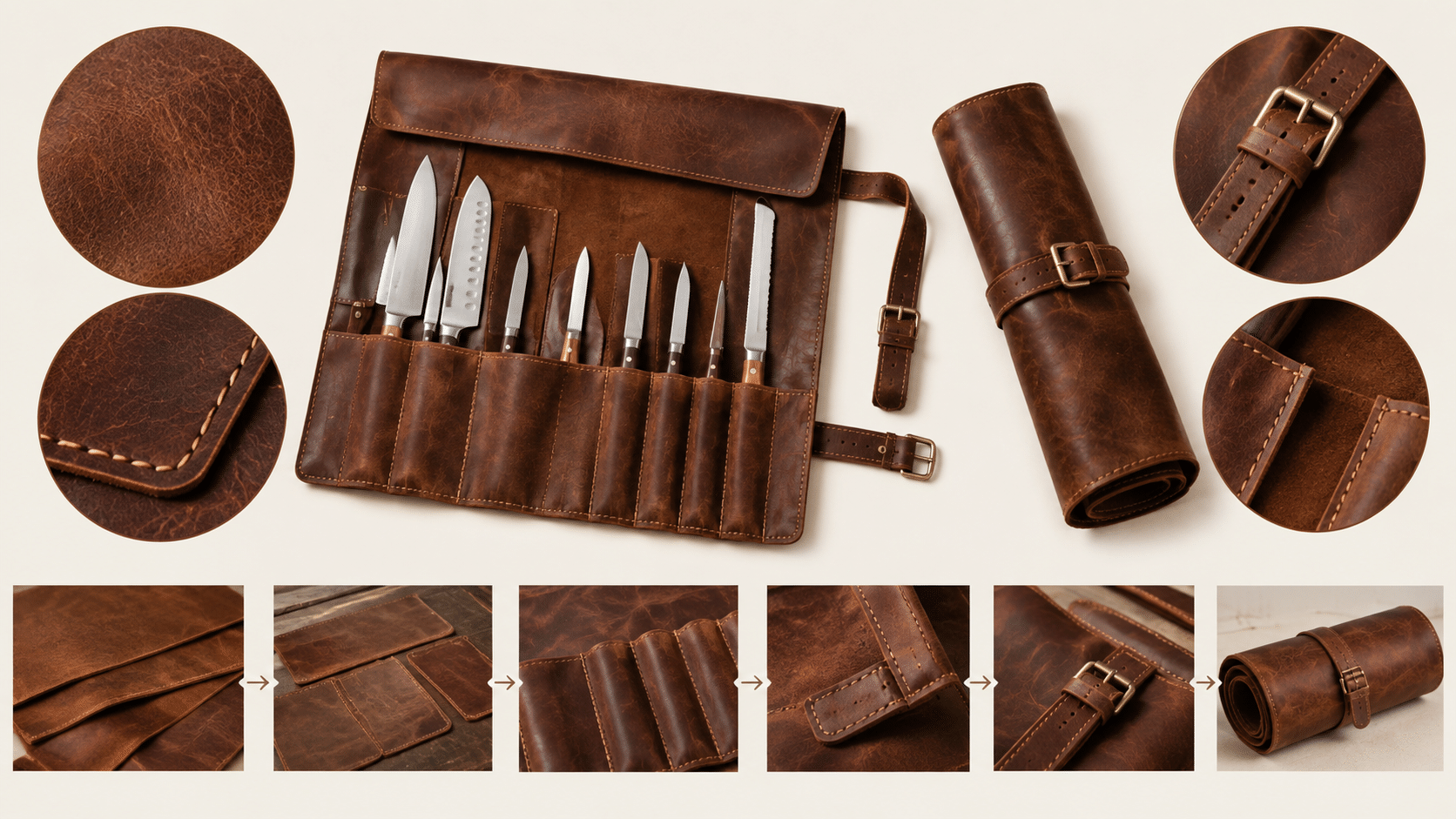

A well-made leather knife roll combines durable leather, reinforced stitching, properly sized compartments, and a secure closure to keep knives protected, organized, and easy to carry. Each part has a specific role, but the overall performance depends on how these components work together.
What Is a Leather Knife Roll Made Of?
A leather knife roll typically consists of a main leather body, individual knife compartments, protective flaps, stitching, and a closure system such as a leather strap, buckle, or snap.
The main components include:
- Durable leather for the outer structure
- Individual pockets or slots for knives
- Stitching to secure the compartments
- A protective flap to cover the knives
- Reinforced areas around high-stress points
- A strap or closure to keep the roll securely closed
Together, these elements create a compact storage system that protects knives while making them easier to transport.
How Leather Affects Knife Roll Construction
Leather Thickness and Durability
Leather thickness affects the structure, flexibility, and durability of a knife roll. Leather that is too thin may provide less structural support, while excessively thick leather can make the roll unnecessarily bulky and difficult to wrap.
The right thickness provides enough strength to hold the knife compartments while still allowing the roll to fold naturally.
Full-Grain Leather for Knife Rolls
Full-grain leather is often selected for high-quality knife rolls because it retains the strongest outer layer of the hide. Its natural strength helps the roll withstand repeated handling, while its surface can develop character over time.
For a durable Leather Knife Roll, the leather should provide a balance between protection, flexibility, and long-term use.
How the Leather Is Cut and Shaped
Construction begins by cutting the leather into the required panels and sections. The main body forms the foundation, while additional leather pieces create the knife slots, protective flap, and closure.
Accurate cutting is important because uneven panels or incorrectly sized sections can affect the final fit and alignment of the roll.
How Stitching Holds a Knife Roll Together
Stitching the Compartments
Individual knife slots are generally formed by securing leather pocket sections to the main body. The stitching divides the available space into separate compartments so knives can remain organized instead of moving against each other.
Consistent stitching also helps maintain the shape of the pockets during regular use.
Reinforced Stress Points
Certain areas experience more tension than others, particularly pocket openings, corners, strap attachments, and closure points. These areas require secure stitching and, in some designs, additional leather reinforcement.
Reinforcing these points helps reduce the risk of seams pulling apart during repeated use.
Why Stitch Quality Matters
Strong leather alone does not make a durable knife roll. The seams also need to withstand the weight and movement of the knives.
Even spacing, secure thread tension, and properly finished stitching contribute to the overall structural strength of the roll.
How Knife Roll Compartments Are Designed
Individual Knife Slots
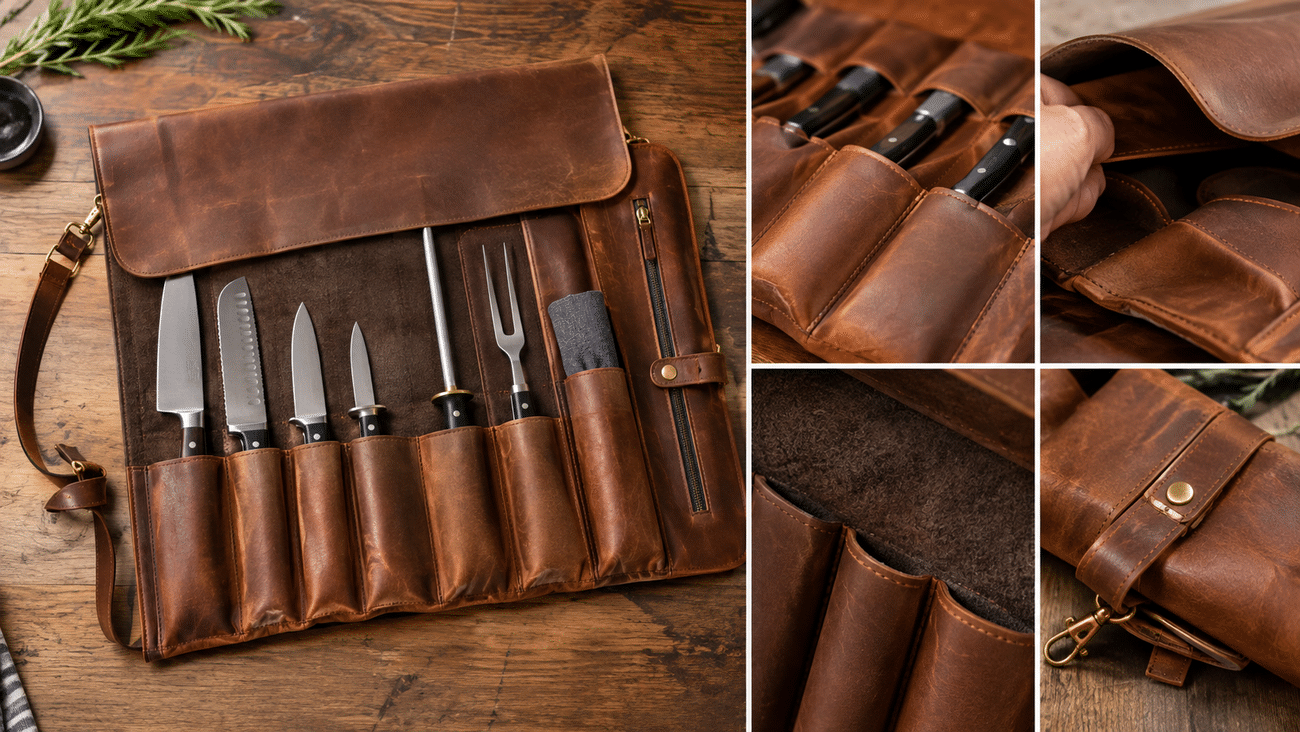
Separate slots keep knives organized and help prevent blades and handles from rubbing against one another. The number of compartments depends on the intended capacity of the roll.
A well-designed Professional Knife Roll should provide enough space for the user’s essential knives without making the roll unnecessarily large.
Different Knife Sizes and Compartment Widths
Knives vary considerably in blade length and handle size. Compartments therefore need to be appropriately sized for the knives they are designed to hold.
A narrow slot may not accommodate a larger handle, while an oversized compartment may allow the knife to move around too much.
Protection Around the Blade
The leather surrounding each knife helps create separation between individual blades. A protective flap can also cover the stored knives when the roll is closed.
This layered construction helps reduce unwanted contact between blades and the rest of the roll.
How the Flap and Closure Protect the Knives
The protective flap covers the knife compartments before the roll is wrapped. It helps keep the knives contained and adds another layer between the blades and the outside environment.
The closure then holds the folded roll in place. Depending on the design, this may be a leather tie, buckle, snap, or another fastening system.
A reliable closure should remain secure during carrying while still being easy to open when the knives are needed.
How the Parts Work Together
A leather knife roll is more than a collection of separate components. Its durability comes from the way those components are assembled.
Leather → Cut Panels → Compartments → Stitching → Reinforcement → Closure → Finished Knife Roll
The leather provides the main structure, the compartments organize the knives, stitching connects the components, reinforcement supports high-stress areas, and the closure keeps everything secured.
This combination allows the roll to remain flexible enough to wrap while providing sufficient protection and organization for the knives inside.
What Makes a Well-Constructed Leather Knife Roll?
A well-constructed knife roll generally includes:
- Durable, appropriately thick leather
- Consistent and secure stitching
- Properly sized knife compartments
- Adequate blade separation
- Reinforced stress points
- A protective flap
- A dependable closure
- A balanced structure that can be rolled and carried comfortably
For culinary professionals, these construction details can be particularly important because the roll may be opened, closed, and transported frequently. Choosing the Best Knife Roll for Culinary use therefore involves looking beyond appearance and considering how the construction handles everyday use.
Frequently Asked Questions About Knife Roll Construction
What is the best leather for a knife roll?
Full-grain leather is a common choice for durable knife rolls because it retains the strongest part of the hide and can provide a good balance of strength, flexibility, and longevity.
How thick should leather be for a knife roll?
The ideal thickness depends on the design and intended use. It should be thick enough to provide structure and protection while remaining flexible enough to roll without excessive bulk.
How are knife compartments stitched into a leather roll?
Leather pocket sections are positioned on the main body and stitched into place to create individual slots. Consistent stitching helps keep the compartments secure and maintain their shape.
How does a leather knife roll protect knives?
Individual compartments separate the knives, while the leather body and protective flap help reduce blade contact with other knives and surrounding objects.
What makes a leather knife roll durable?
Durability comes from the combination of quality leather, strong stitching, reinforced stress points, properly constructed compartments, and a secure closure system.
Conclusion
The construction of a leather knife roll depends on several components working together. Durable leather provides the foundation, compartments keep knives organized, stitching holds the structure together, reinforcement strengthens high-stress areas, and the closure keeps the finished roll securely wrapped.
When these elements are properly designed and assembled, the result is a practical knife storage solution that provides organization, protection, and reliable portability.