
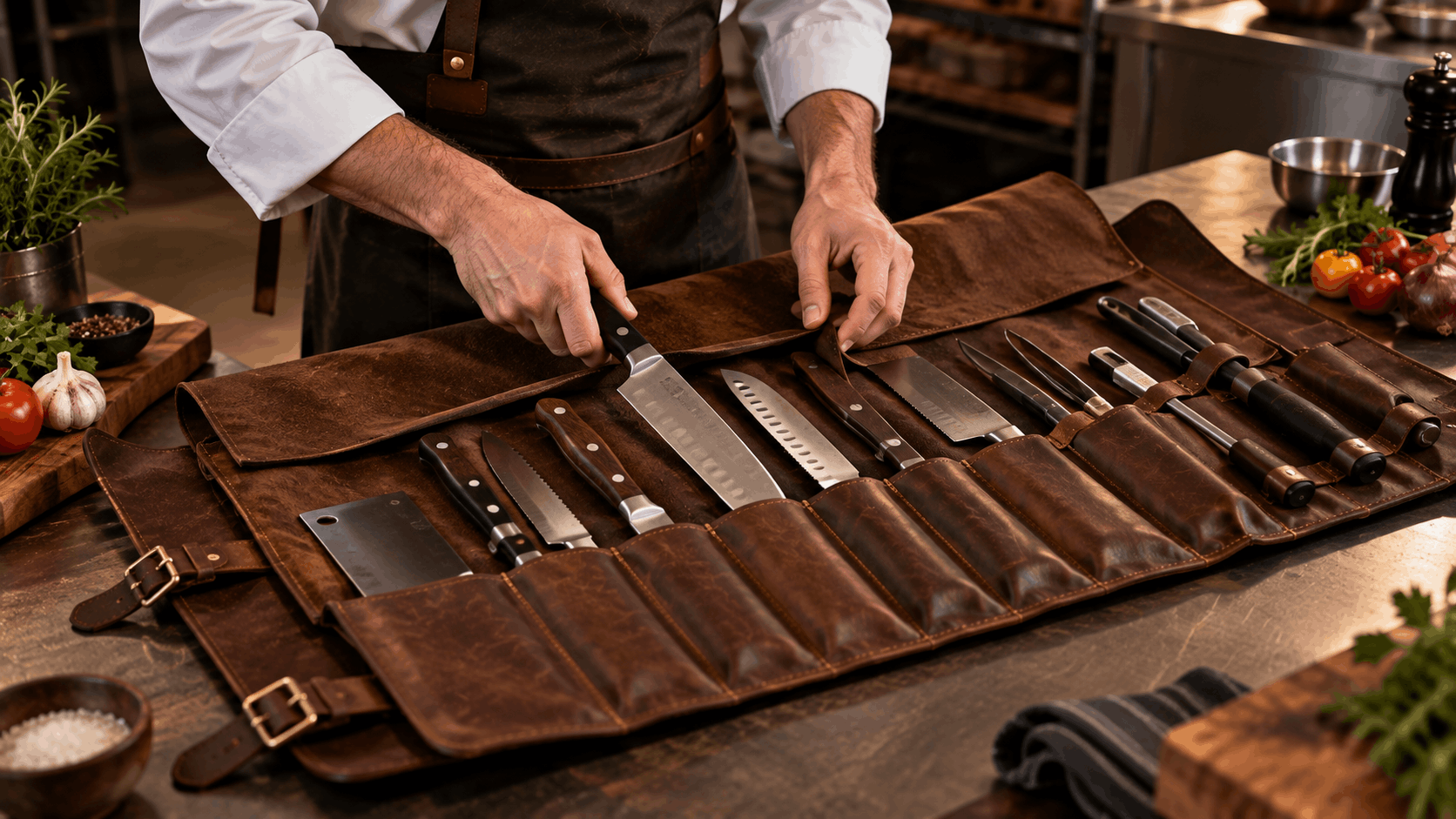

A professional knife roll should protect your knives while keeping them organized and easy to transport. The right fit helps prevent blades from shifting, contacting each other, or becoming difficult to remove during work or travel.
The ideal knife roll depends on the size and number of knives in your collection, along with any sharpening tools or accessories you carry. A good design should provide secure storage without becoming unnecessarily bulky.
What Makes a Knife Roll Fit a Chef Knife Collection?
A properly fitted knife roll should accommodate your knives without forcing them into the pockets or leaving excessive space around the blades. Key features include:
- Correct pocket size and depth
- Enough slots for your knife collection
- Secure knife retention
- Adequate spacing between knives
- Room for essential accessories
- A compact but practical overall design
For a deeper look at available options, see our guide to Best Leather Knife Rolls.
How Should a Knife Roll Fit Different Knife Sizes?
Professional knife collections often contain blades of different lengths and shapes. Each should have a suitable pocket or compartment.
Chef Knives
A chef knife usually needs a deep, secure slot that accommodates its blade length and handle without putting unnecessary pressure on the knife.
Paring Knives
Smaller paring knives work best in narrower pockets that prevent them from moving around inside the roll.
Utility Knives
Utility knives need enough pocket depth to keep the blade secure while allowing the handle to remain easy to access.
Bread Knives
Long bread knives require an appropriately long pocket. The blade should fit fully inside without extending into neighboring compartments.
Boning and Fillet Knives
These narrow, flexible knives should have dedicated slots that keep them separated from larger blades.
Cleavers and Other Large Tools
Cleavers and other wider or heavier tools require reinforced compartments with enough width and depth to hold them securely.
How Many Knives Should a Professional Knife Roll Hold?
The right capacity depends on the knives you actually use. A roll with too few slots may force you to leave essential knives behind, while an oversized roll can add unnecessary weight and unused space.
Start by counting your current knives and identifying which ones you regularly use. Then consider whether you expect to add more knives in the future. A little extra capacity can be useful, but the roll should still remain practical to carry.
Our guide on Professional Chefs Prefer Leather Knife Rolls covers why leather remains a practical choice for professional kitchen gear.
What Features Should a Professional Knife Roll Have?
A professional knife roll should combine secure storage, protection, and easy portability.
Properly Sized Knife Slots
Each slot should provide enough depth and width for the intended knife. The knife should sit securely without being difficult to remove.
Secure Closures or Straps
Buckles, straps, snaps, or other closures should keep the roll firmly closed during transport.
Durable Protective Material
Leather and other durable materials can provide a strong outer layer against everyday wear during travel and professional use.
Reinforced Stitching
Stitching around pockets, straps, and closure points should be strong enough to withstand repeated opening, closing, and carrying.
Protective Interior
A suitable interior lining or pocket construction can help keep knives separated and reduce unnecessary contact between blades and other equipment.
Handle or Shoulder Strap
A strong carrying handle or shoulder strap makes the knife roll easier to transport between kitchens, culinary classes, restaurants, and events.
Additional Storage
Extra pockets can provide space for sharpening tools, thermometers, tweezers, markers, or other small accessories.
How Do You Know if Your Knife Roll Is Too Small or Too Large?
A knife roll is too small when knives are difficult to insert, pockets cannot accommodate the full blade length, or the roll must be placed under excessive pressure to close.
It is too large when knives have excessive room to shift, the roll contains many unused compartments, or its size and weight make transportation unnecessarily difficult.
The correct fit should allow each knife to remain secure while the roll closes naturally.
How to Choose the Right Knife Roll for Your Collection
Start by counting the knives you regularly carry and measuring your largest blades. Then check the dimensions and depth of the knife roll’s individual pockets rather than relying only on the stated capacity.
Also consider accessories, carrying style, and future additions to your collection. Culinary students may need a different capacity from a professional chef carrying a specialized set. Our guide to the Best Knife Roll for Culinary explains what to consider when choosing a roll for culinary training and everyday student use.
Before buying, check:
- Number of available knife slots
- Pocket dimensions and depth
- Largest knife capacity
- Space for accessories
- Closure system
- Carrying handle or shoulder strap
- Overall size and weight
FAQs
How many knives should a professional knife roll hold?
There is no fixed number. Choose a capacity that covers the knives you regularly use while leaving a small amount of room for future additions.
What size knife roll do I need?
Measure your longest and widest knives and compare them with the pocket dimensions. The roll should accommodate your largest knife without forcing the blade into the slot.
Can a knife roll hold different sizes of chef knives?
Yes. A well-designed knife roll can accommodate different knife sizes when it provides a combination of pocket lengths and widths suitable for the collection.
Should knife pockets be tight or loose?
Pockets should hold knives securely without making them difficult to insert or remove. Excessively tight pockets can make access difficult, while loose pockets allow unnecessary movement.
What should I carry in a professional knife roll?
Carry the knives you regularly need along with essential accessories such as a sharpening tool and other small kitchen equipment. Avoid filling the roll with unnecessary items that add weight and bulk.